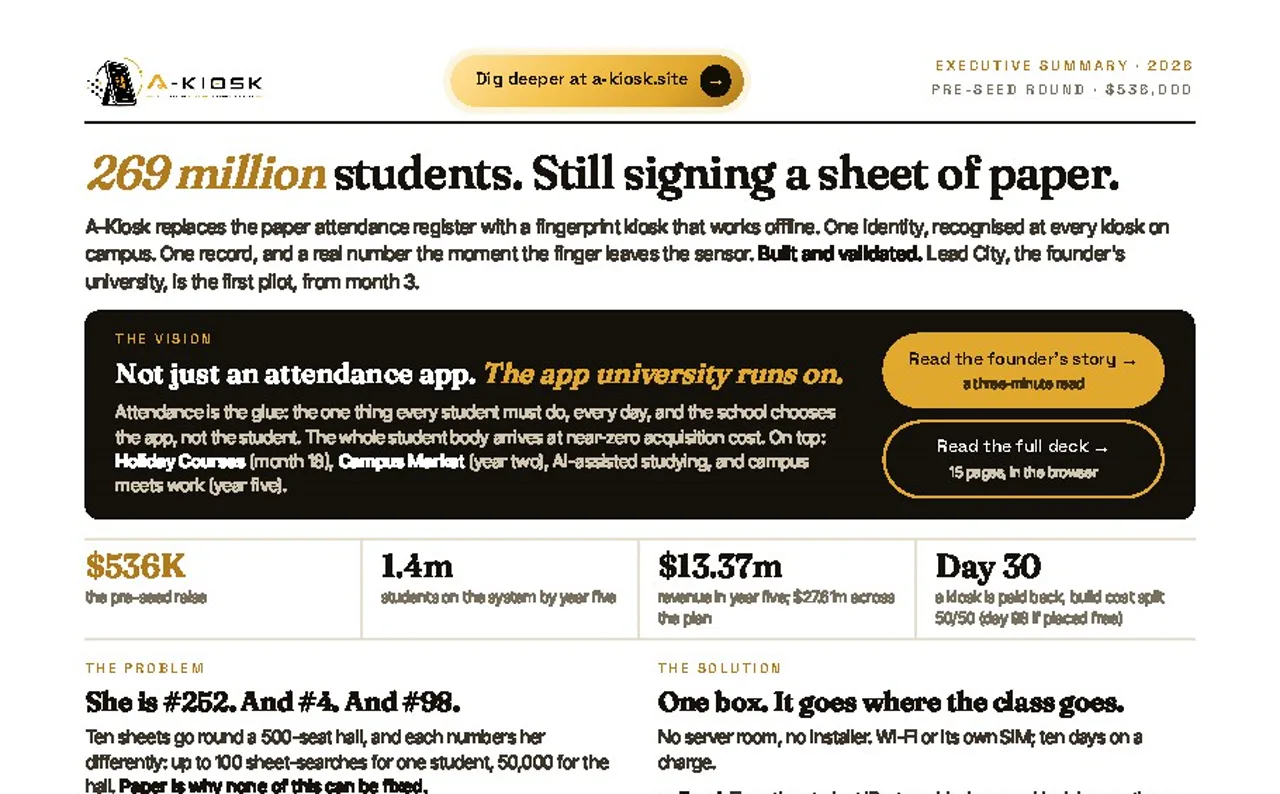
269 million students. Still signing a sheet of paper.
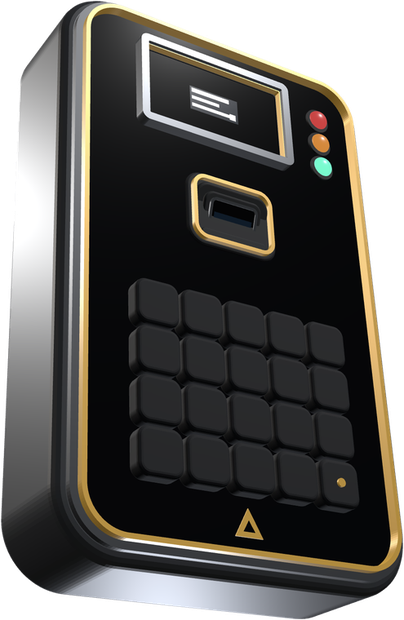
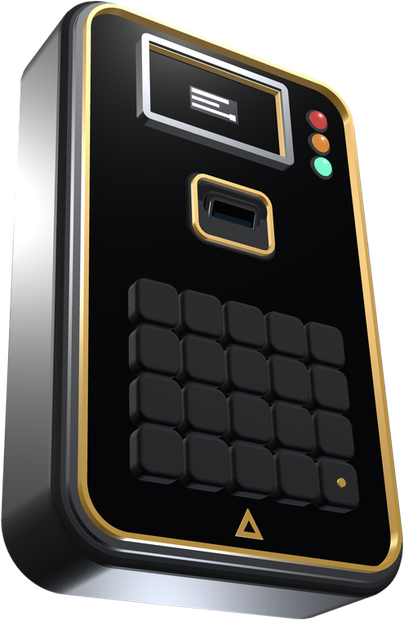
A-Kiosk replaces the paper register with a fingerprint kiosk that works with no power and no network — and turns every tap into the mark, the exam-board sheet and the early warning a university already needs.
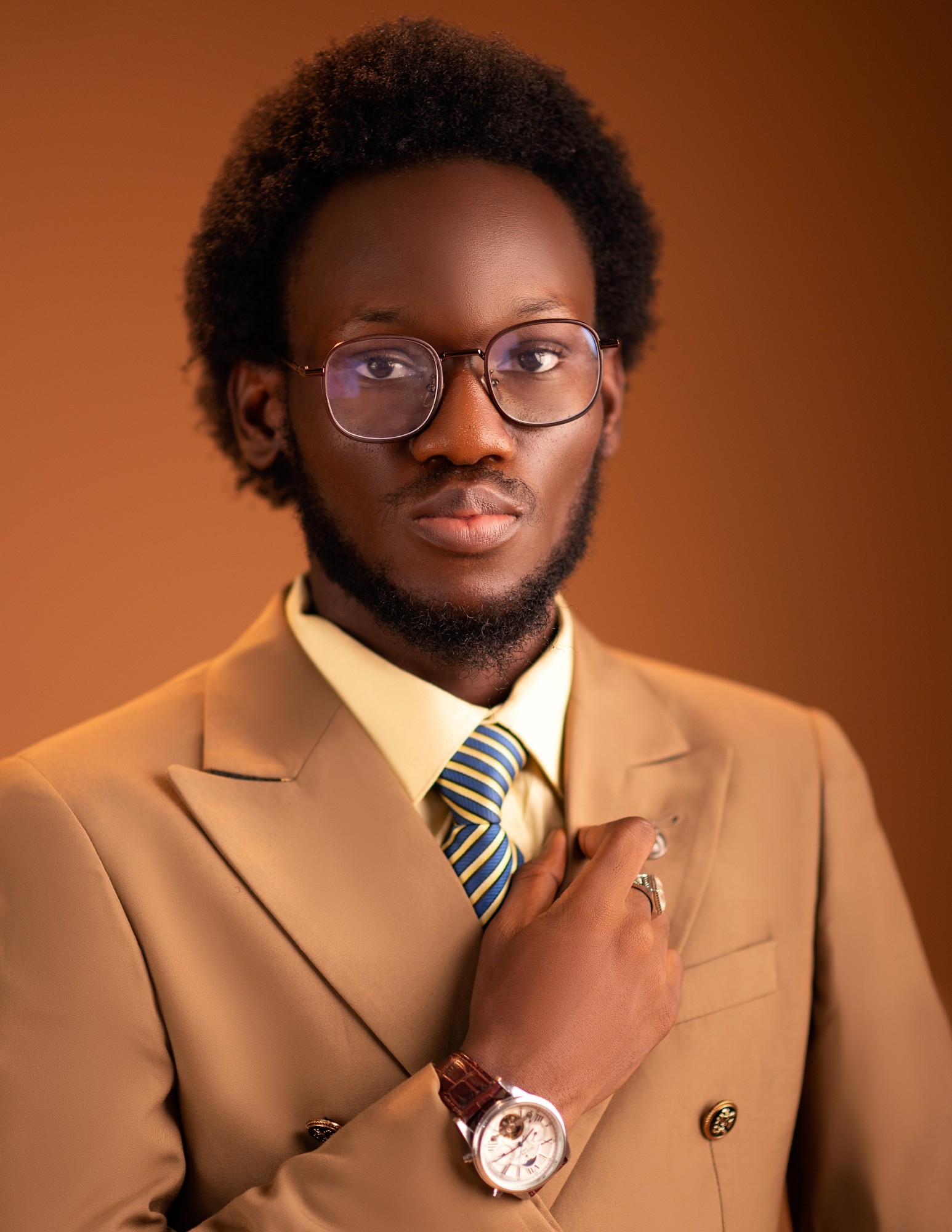
“Paper registers cost me an A, and made me write a 2.5-hour exam in 1.5. So I built the fix.”
Adeyemi Abdul Basit AdetunjiFounder · CEO and CTO · 21 · First Class, Electrical & Electronic Engineering- Built every layer — firmware, server, hardware
- 143 firmware revisions
- Paid for the first prototype from his food money
The register that proved I attended went missing.
Wrongly marked ineligible, I spent the first hour at the Senate clearing my name.
See it working.
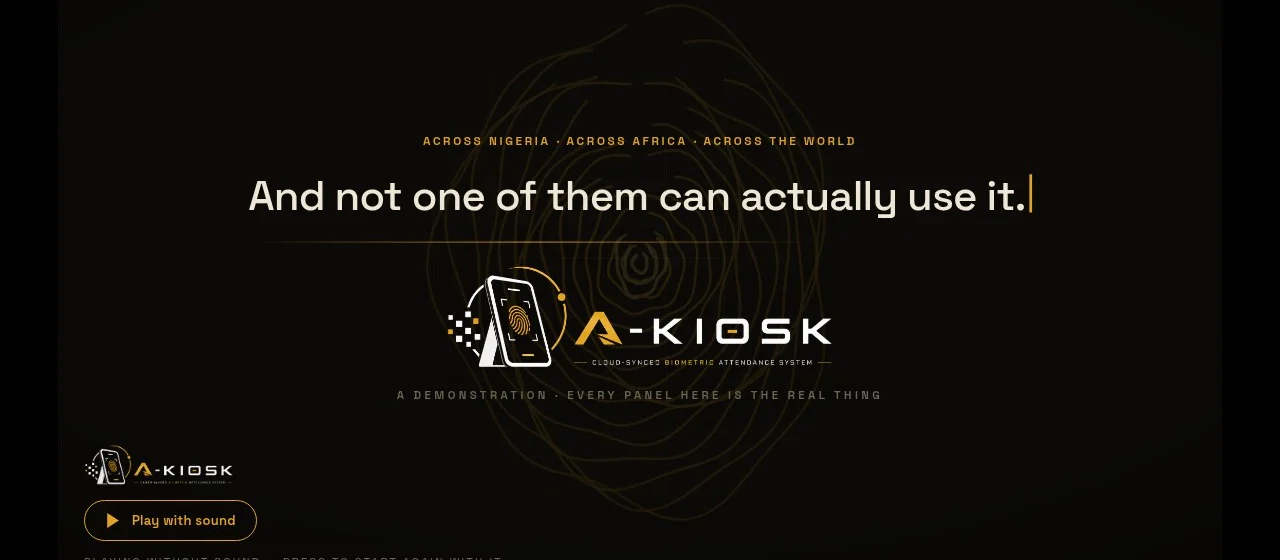 Real screens: enrol, open a class, tap, and everything that follows. 4½ minutes.
She is #252. And #4. And #98.
Ten sheets go round a 500-seat hall, because no single sheet holds everyone, and each one numbers her differently. Somebody tired then works out her mark by hand: up to 100 sheet-searches for one student, 50,000 for the hall, with nothing to check the answer against.
Keep scrolling. Read the deck.
It buys 200,000 students in year one after the pilot, and the last 100,000 in year two. Every line is a headcount, a unit count or a filing — costed from what it buys.
921m students (269m at university, 652m at secondary school) + 1.91bn workers + Holiday Courses & Campus Market, sized on the 269m university students. Rings not to scale.
of the $536K returned by the first year after the pilot, on its own — 89.14% counting the pilot term before it.
spent on paper, per student, every year — today
our entry fee (₦3,000), for a live register
Billed on the invoice the school already issues, alongside tuition. 0.20% of the lowest private-university tuition in our first market.
Not just an attendance app. The app university runs on.
Attendance is the glue: the one thing every student must do, every day, in every class, and the school chooses the app, not the student. So a university that adopts A-Kiosk brings its whole student body with it. Nobody opts out and we pay nothing to acquire them, which is a daily habit with verified identities at close to zero acquisition cost. We use it to make the whole university experience better.
Every student, every class, every day. Paid by the school.
Courses in your own discipline while the school is out. From month 18.
Student businesses, found by their own school. From year two.
Graduates hired through a record they earned. Year five.
The holidays, put to work. Graduates who are employable.
A-Kiosk knows the academic calendar, so it knows the moment a school vacates, and it knows each student’s department and level. When the holiday starts, it recommends courses in the student’s own discipline: CAD for an engineer, modelling and tax for an accountant, drafting and research for a law student, plus the skills every graduate needs. Each course is ₦15,000 ($11.11), paid in the app. The goal is a graduate who leaves with skills an employer wants, not only a certificate.
More than a register. A market for every student who builds something.
One in four students where we start already runs a business: cakes on a Friday, braids in the hostel, phone repairs between lectures. Most of them sell to whoever happens to see a WhatsApp status. Campus Market gives every one of them a real shop front inside the app their whole school already opens every day. List once, get found by anyone on campus searching “makeup”, “cake” or “laundry”, and meet the buyer that same evening. For the student it is a first business with real customers, real reviews and a real track record: the entrepreneurship a lecture can only describe, practised while they study.
Why this follows from attendance. A marketplace lives or dies on three things: enough people, people who are who they say they are, and a reason to come back every day. Attendance gives us all three before we sell a single listing: the whole student body, each verified by fingerprint and tied to their campus, opening the app every day because the school requires it. Other marketplaces spend most of their money buying exactly that. For us it is already paid for, so Campus Market is the next room in the house, not a new business.
For example:
Year five: campus meets work. By year five A-Kiosk is inside both markets: universities, where it holds every student’s verified record (attendance, punctuality, how consistently they showed up, year after year), and employers, where it already verifies staff every day. Then we link the two. A graduating student shares their verified record with one tap; an employer already on A-Kiosk finds and hires them directly, and the same identity carries on from the lecture hall into the workplace. A job board where every candidate is real and every record was earned.
Everything behind the deck.
Open now, no sign-up.
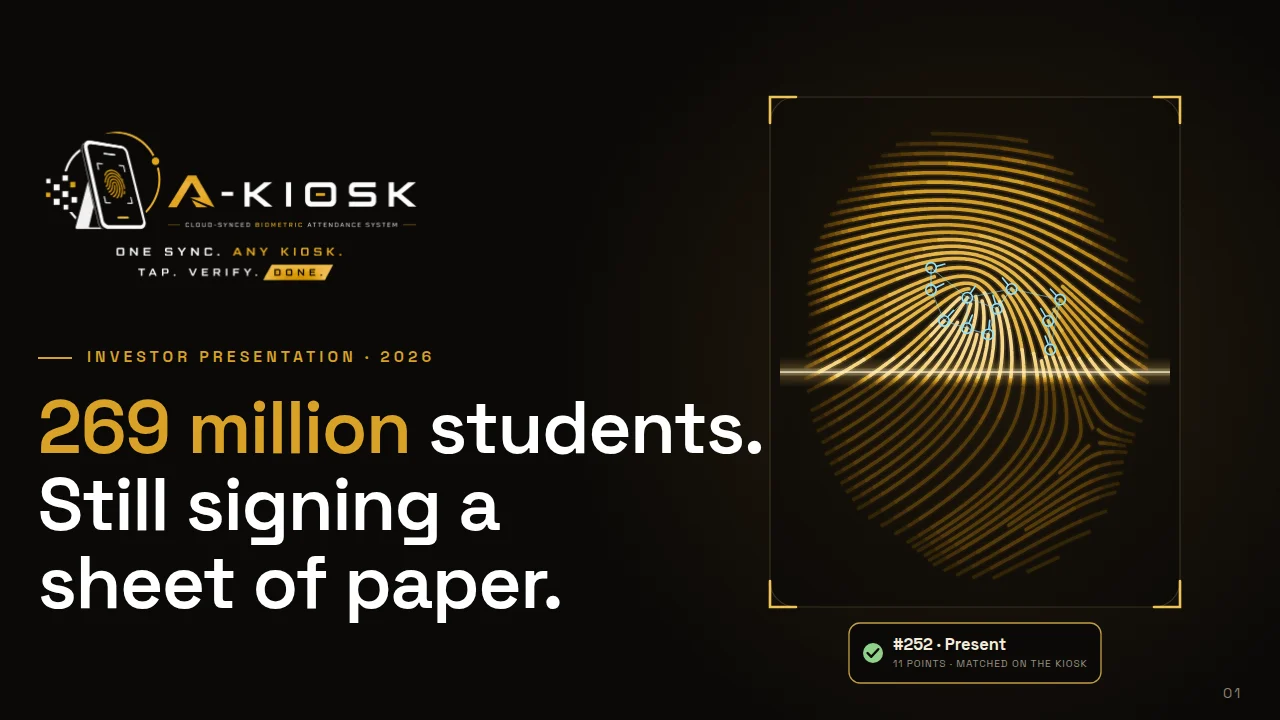
The comprehensive pitch deck. The pitch.
The problem, the product, the market, the money and the ask — the source every other document matches.

The founder’s story.
The Lab in My Mother’s Room — why one person holds both seats.
Product demonstration
Real screens, not a mockup: enrol, open a class, tap, and everything that derives from it.
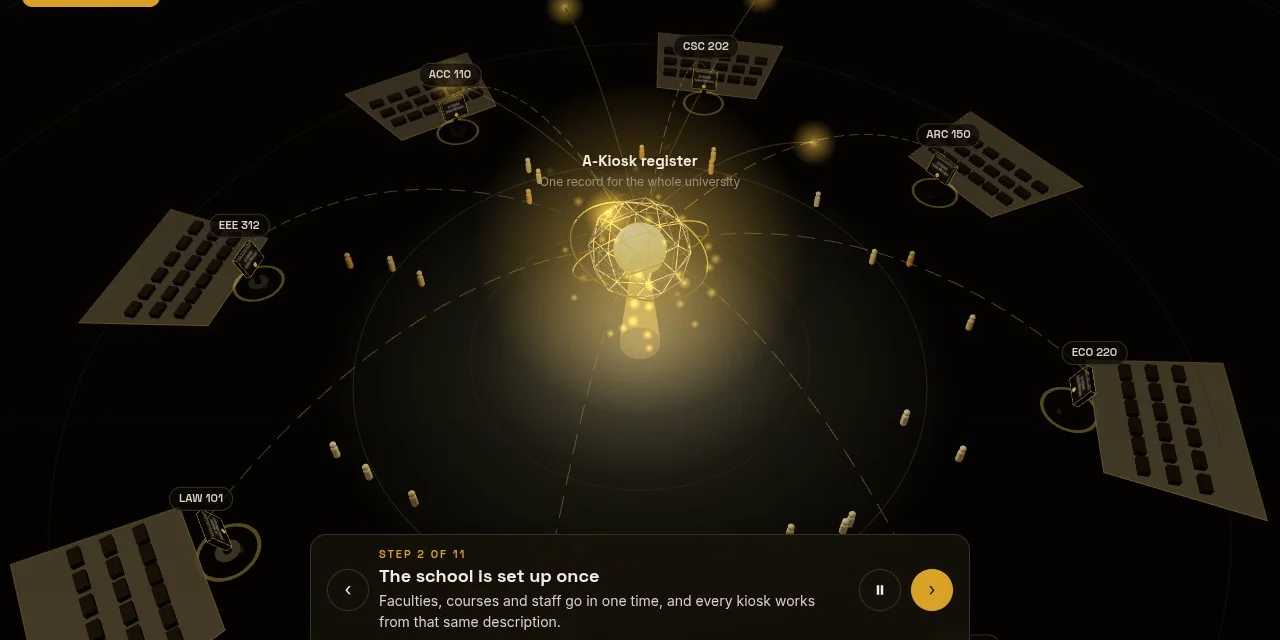
See it in 3D
The kiosk, the halls and a class signing in — how a tap becomes a mark, animated in your browser.
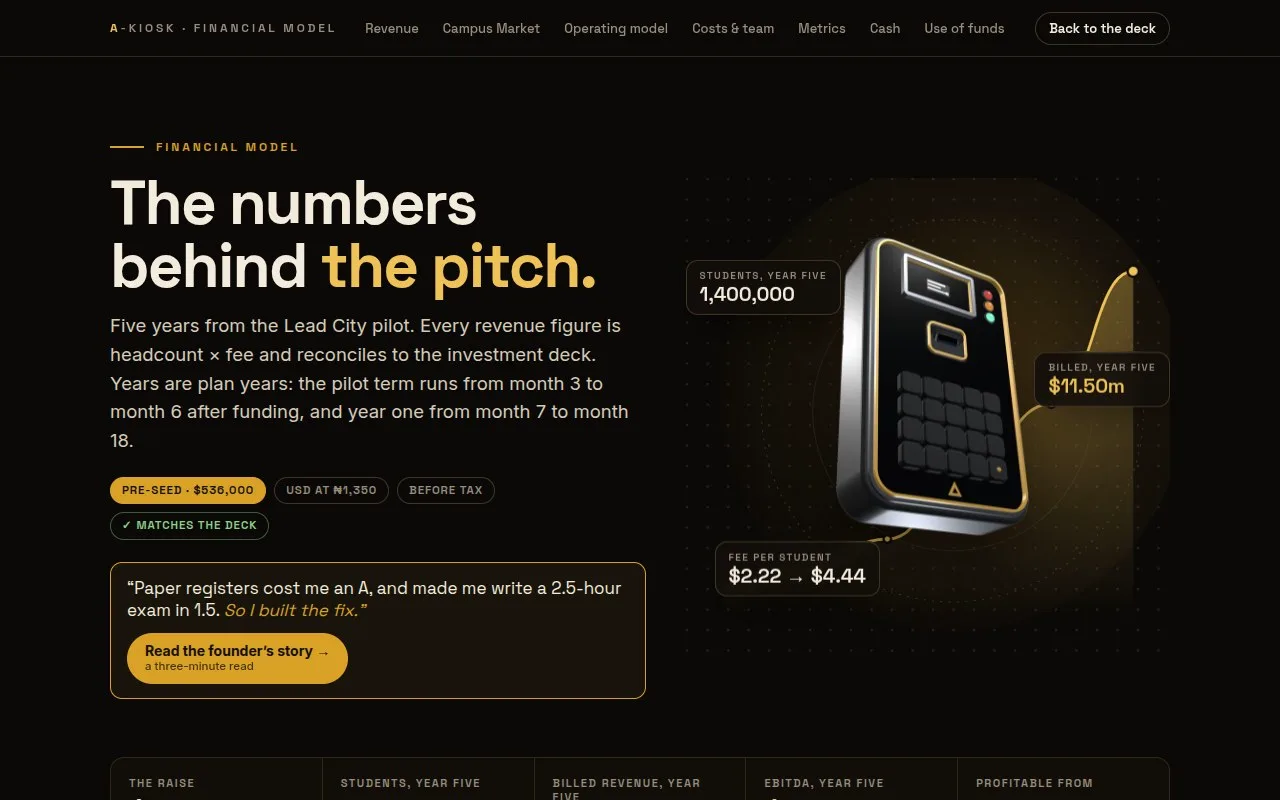
Financial model
Revenue, costs, cash, unit economics, risks. Every assumption editable.
Executive summary
The whole case on a few pages, for the partner meeting.
more university students than in 2000
UNESCO, 2023of lecturers see fewer students in class
Times Higher Educationof people live under mobile data
ITU, 2024of smartphones have biometrics on
Cisco Duo, 2022per student for our kiosk, at most
Our build costgrowth in Sub-Saharan Africa’s universities and colleges, the fastest in the world
UNESCO, 2022people already enrolled in a single biometric ID system
UIDAI (Aadhaar), 2025university students worldwide already runs a business: Campus Market’s sellers
GUESSS, 2023Every number is in the financial model.
The build risk is already retired.
You are funding distribution, not whether this can be made. The kiosk, the firmware, the server, the sync and the over-the-air updates exist and run end to end today. Lead City University is the intended first pilot.
A fingerprint terminal
separate enrolments — the student enrols again at every machine.
- Someone carries a USB stick to every terminal, every evening
- Spreadsheets reconciled by hand at the end of term
- Stops when the power goes
- Records that a finger touched a sensor. Nothing more.
A-Kiosk
enrolments — one each, once. Every kiosk knows them within the hour.
- Each kiosk sends every tap itself, over Wi-Fi or its own SIM
- Marks computed while the term runs, ready for the exam board
- Ten days on a charge; taps queue and drain later
- Understands semesters, levels, courses, lecturers, excusals
From one hall to every student.
The finger is the hard part, and it is already done. Every register after that is a smaller job.
Paper attendance vs A-Kiosk.
| Paper | A-Kiosk | |
|---|---|---|
| Who can sign | Anyone holding the pen, no identity check at all | Only the actual student, by fingerprint |
| A full lecture hall | Multiple sheets, cross-referenced by hand | One tap, one record, instantly |
| Power | Needs power every time sheets are printed and copied | Rechargeable, up to 10 days per charge |
| Grading | Reconciled by hand, after the fact | Calculated live |
| Early warning | None, reviewed too late to act | Automatic at-risk detection |
| Oversight | A single flat view, if any | Deans and HODs check attendance from their phone, anytime; Senate gets a full accountability trail |
| History | Boxed and stored, often lost after a few years | Every past semester preserved and searchable |
What it already does.
Enrol once at any kiosk and be recognised at every kiosk on campus, online or fully offline.
Catches the slow decliner and the sudden vanisher. Watching for only one misses the other.
Live session tracking shows which classes are actually running, not just who misses them.
A streak that survives an excused absence, personal bests and an opt-in leaderboard.
A reason kept on record, and the grade recalculates immediately and transparently.
Every semester’s record stays intact and auditable, in one searchable archive.
Lecturer, HOD, Dean and Senate each see their own scope, enforced on every request.
Attendance becomes a weighted grade, with a locked, printable eligibility sheet ready to sign.
What A-Kiosk becomes next.
The same fingerprint that opens a lecture opens an exam hall, so the person who sat the paper is provably the person on the roll.
Every student business, searchable by every student in the same school, from year two: a first business with real customers.
An optional, verified view of attendance for a parent or sponsor. Off by default, switched on per university.
Courses in each student’s own discipline, sold in the app while the school is on holiday: ₦15,000 ($11.11) a course. Graduates leave with skills an employer wants.
Once A-Kiosk serves both universities and employers, we connect them: a graduate shares a verified record of how reliably they showed up, and employers already on A-Kiosk find and hire them. One identity, from lecture hall to workplace.
Live lectures inside A-Kiosk, with attendance taken in the same register as the hall.
Class groups and announcements run by the school, so school leaves personal chat apps.
Flashcards from lecture notes, practice quizzes, revision plans timed to the exam timetable, catch-up summaries of missed classes, and a study assistant for every course.
Built on what A-Kiosk already knows about each student’s courses and timetable: flashcards made from lecture notes and slides; practice quizzes before each test; a revision plan timed to the exam timetable, with spaced repetition; a catch-up summary of any class a student missed; a study assistant that answers questions from the course material; and extra support offered automatically to a student the at-risk detection has already flagged.
The kiosk is built. The first hall is waiting.
$536K puts A-Kiosk in its first building. Every one after is a smaller job.

The person selling it is the person who built it — firmware, server and hardware.
Read the founder’s story →