The numbers behind the pitch.
Five years from the Lead City pilot. Every revenue figure is headcount × fee and reconciles to the investment deck. Years are plan years: the pilot term runs from month 3 to month 6 after funding, and year one from month 7 to month 18.
“Paper registers cost me an A, and made me write a 2.5-hour exam in 1.5. So I built the fix.”Read the founder’s story →a three-minute readNot just an attendance app. The app university runs on.
Attendance is the glue. It is the one thing every student must do, every day, in every class, and the school chooses the app, not the student. So a university that adopts A-Kiosk brings its whole student body with it: nobody can opt out, and we pay nothing to acquire them. That makes our cost of acquiring a user close to zero, and it gives us what every consumer app pays fortunes for: a daily habit, with verified identities. We use it to make university life better.
Every student, every class, every day. Paid by the school.
Courses in your own discipline while the school is out, so graduates leave employable. From month 18.
Student businesses, found by their own school. From year two.
Graduates hired through a record they earned. Year five.
Students × fee. Then every other register.
One compulsory fee per student per year, billed on the invoice the school already issues. It phases from ₦3,000 ($2.22) to ₦6,000 ($4.44) as a school settles in. From year 3.5 the same machine goes to the easiest employers first: a state or agency takes a yearly verification contract to eliminate ghost workers, and a factory takes a yearly site licence and buys its own machines. From month 18, Holiday Courses sells courses in each student’s own discipline while the school is on vacation, and from year two Campus Market adds a fee from students who run businesses. Billed is what the deck shows. Collected applies the collection rate. Not every school pays in full, and not on time.
Holiday Courses. The holidays, put to work.
A-Kiosk knows the academic calendar, so it knows the moment a school vacates, and it knows each student’s department and level. So when the holiday starts, Holiday Courses opens with courses matched to the student’s own discipline, recommended for them: an engineering student is offered CAD or embedded systems, an accounting student modelling and tax, a law student drafting and research, alongside skills every graduate needs, like data, design, public speaking and starting a business. Each course is ₦15,000 ($11.11), paid in the app. The aim is a graduate who leaves with skills an employer wants, not only a certificate: a more employable generation, and a better university experience along the way.
across the plan. Sized at one ₦15,000 ($11.11) course per tertiary student a year: 269m students worldwide (UNESCO), 15m in Sub-Saharan Africa.
Campus Market. A market for every student who builds something.
One in four students where we start already runs a business: cakes on a Friday, braids in the hostel, phone repairs between lectures. Most of them sell to whoever happens to see a WhatsApp status. Campus Market gives every one of them a real shop front inside the app their whole school already opens every day. List once, get found by anyone on campus searching “makeup”, “cake” or “laundry”, and meet the buyer that same evening. For the student it is a first business with real customers, real reviews and a real track record: the entrepreneurship a lecture can only describe, practised while they study.
Name, what you sell, a few photos and how to reach you. Verified by the same enrolment that signs you into class.
Search is scoped to your campus, so every result is somebody you can meet today.
Every seller is a fingerprint-verified student, which no marketplace or WhatsApp group can offer.
Cakes & pastriesSmall chopsPopcorn & snacksThrift clothesPerfumesPhone accessoriesHair productsJewelleryand many more…
MakeupHair braidingBarbingPhotographyLaundryTutoringPhone & laptop repairGraphic designand many more…
Conservative on purpose: 1 in 4 students runs a business (The Garage, State of Student Work, 4,000+ students at 55 Nigerian institutions), and the plan assumes only 10% of them list. The market is sized at ₦25,000 ($18.52) per tertiary student a year, across the world’s 269m. across the plan.
Where each dollar of fee goes.
Fixed costs are the team, sales, product, legal and offices. Variable costs follow the number of students served: connectivity, cloud, support, collection. Kiosks are capital spend, since we build them and place them at cost. They sit below the operating line. Entry into Kenya, Ghana and Tanzania, from year 4.5, has no line of its own: its costs sit inside the year-four and year-five fixed costs, and all revenue is modelled in naira.
What the fixed costs buy, line by line.
The deck shows one number for the raise. This splits every year's fixed costs by function. The split is editable below.
The numbers an investor checks first.
Recurring revenue run-rate, what each new student costs to win, how fast they pay that back, and how many students the business needs to cover its fixed costs.
Definitions. ARR: annual recurring revenue, the students on the system at the end of the period × that year's fee. CAC: sales & marketing plus kiosks built for new students, divided by new students. Payback: CAC ÷ monthly contribution per student. Gross margin: collected revenue less variable costs. Break-even students: fixed costs ÷ contribution per student.
The raise, and where the cash goes from there.
Opening cash is the $536,000 raise. Each period adds collected revenue and subtracts operating costs and kiosks. The lowest balance is the real test of whether the round is big enough.
Month by month, through the first two years
The annual view assumes fees arrive evenly. They do not: a school is billed once, when it joins, then pays about 2 months later. Kiosks are built the month before a school goes live. This is the same plan, month by month, with that timing. The low point is what the round has to cover.
$536,000. Every line is a headcount, a unit count or a filing.
It buys 200,000 students in year one after the pilot, and the last 100,000 in year two. Hardware is 2,000 kiosks, built at cost and placed free.
One school, one student, one kiosk.
We do not sell machines. The kiosk is how a school joins. We take no margin on it and earn on the subscription.
Why schools already pay this. Schools already spend ₦2,720 ($2.01) per student a year on paper attendance.
What is inside a $37–60 kiosk.
Every part is off the shelf and sourced separately, so no single supplier sets the price. We build at cost and place it with the school, so the hardware is how a school joins, not a product line.
| Part | What it does |
|---|---|
| Controller | Runs the kiosk and keeps working offline. |
| Fingerprint reader | Recognises a student in about a second. |
| Screen and keypad | Shows each step; takes a PIN or ID. |
| Clock and storage | Every tap keeps its true time, even offline. |
| Battery | Days of use on one charge. |
| Lamps, sound, casing | Seen across a hall; built for a lecture theatre. |
| V2 adds: mobile connection | Works where the campus has no Wi-Fi. |
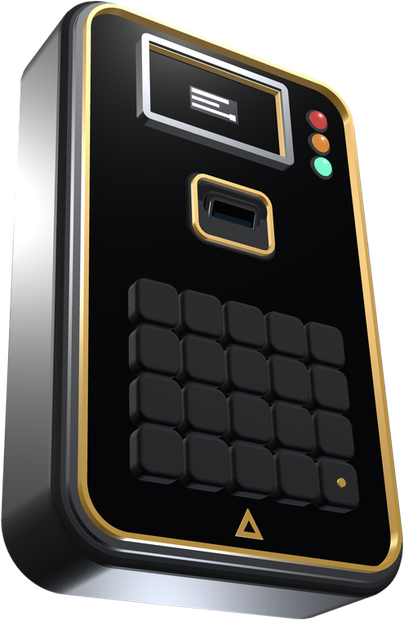
The same box in every hall. V1 uses the campus Wi-Fi; V2 adds its own SIM where there is none.
A kiosk, at pilot volumes. The model uses $60, the top of the range, throughout.
Paid once, against a fee paid every year.
Kiosks in the field, with 10% rebuilt each year for wear, damage and theft.
Two ways to place a kiosk
A school either splits the build cost with us 50/50, or we place the kiosk free. Either way the school pays the same yearly fee per student, and that fee is where the money comes from. The plan uses the free model, the more cautious of the two.
What moves year-five operating profit.
Year-five EBITDA under different mature fees and different levels of signing, holding everything else as set below. The highlighted cell is the plan.
The fee is in naira. Some costs are not.
Schools pay in naira, while kiosk parts are priced in dollars. If the naira weakens, dollar revenue falls. People and most running costs are paid in naira, so they fall with it; hardware does not. The model counts 70% of fixed costs and 50% of variable costs as paid in naira.
How we protect it. The fee is reviewed with each school once a year, and the deck's own ₦3,000 → ₦6,000 ($2.22 → $4.44) phasing is itself a repricing. Kiosk parts are bought in batches ahead of each season, so one fall in the naira does not reprice the whole fleet.
Attendance and Nigeria are where we start. Neither is the size of the prize.
Five streams, counted by sector, not by border, with nobody counted twice. Campus Market: student businesses listed in the app at ₦25,000 ($18.52) a semester. Holiday Courses: short courses sold in the app during the vacation at ₦15,000 ($11.11) each. Students on the full platform (the register plus online classes and school messaging) at $10 a year. Workplaces on a yearly site licence or verification contract, sized to the workforce it covers: about $13.33 a year for each person on it, far below what lost hours and ghost workers already cost. Machines sold to sites that want to own them.
Step by step, not all or nothing
Students already on a register × the fee, nothing else. We do not need all of anywhere — half is a business; all of it is a ceiling. The last row is how much of each step the plan needs by year five.
| Students already on a register | Half of Nigeria | Nigeria | Half of Africa | 75% of Africa | Africa | 25% of the world | Half the world | The world |
|---|---|---|---|---|---|---|---|---|
| Universities and polytechnics | 1.3m | 2.6m | 7.5m | 11.25m | 15m | 67.25m | 134m | 269m |
| Secondary schools | 7.6m | 15.2m | 41m | 60.75m | 81m | 163m | 326m | 652m |
| Both, together | 8.9m | 17.8m | 48m | 72m | 96m | 230.25m | 460m | 921m |
| A year at the $2.22 entry fee | $19.78m | $39.56m | $106.67m | $160m | $213.33m | $511.67m | $1.02bn | $2.05bn |
| A year at the $4.44 mature fee | $39.56m | $79.11m | $213.33m | $320m | $426.67m | $1.02bn | $2.04bn | $4.09bn |
| The plan’s 1.4m students in year five, as a share | 15.73% | 7.87% | 2.92% | 1.94% | 1.46% | 0.61% | 0.30% | 0.15% |
| Students | Headcount | Register only, $4.44 | Full platform, $10 |
|---|---|---|---|
| Tertiary studentsUniversities and polytechnics · UNESCO | 269m | $1.19bn | $2.69bn |
| Secondary studentsWorld Bank / UNESCO, 2023–24 | 652m | $2.89bn | $6.52bn |
| All students, worldwide | 921m | $4.09bn | $9.21bn |
| Of which Sub-Saharan Africa | 96m | $426m | $960m |
| Workplaces: a yearly licence, paid by the employer | Headcount | At our licence ($13.33 a year per person covered) | At HR-software pricing ($44.44) |
|---|---|---|---|
| Wage & salaried workers, worldwideLabour force 3.74bn, less 4.8% unemployment, × the 53.6% who work for an employer · World Bank / ILO, 2025 | 1.91bn | $25.47bn | $84.89bn |
| Wage & salaried workers, Sub-Saharan AfricaAbout 460m in work, roughly a quarter of them for an employer · ILO estimate | ≈110m | $1.47bn | $4.89bn |
| Machines sold, on top | People | Machines | Replaced a year, 5-year life | A year at $200 each |
|---|---|---|---|---|
| Wage & salaried workers, worldwideLabour force 3.74bn, less 4.8% unemployment, × the 53.6% who work for an employer · World Bank / ILO, 2025 | 1.91bn | 19.10m | 3.82m | $764.00m |
| Exam candidates, worldwideOne year-group of the secondary row | 109m | 1.09m | 218K | $43.60m |
| Worldwide, into the TAM | 2.02bn | 20.20m | 4.04m | $808.00m |
| Wage & salaried workers, Sub-Saharan AfricaAbout 460m in work, roughly a quarter of them for an employer · ILO estimate | ≈110m | 1.10m | 220K | $44.00m |
| Exam candidates, Sub-Saharan AfricaOne year-group of the region’s 81m secondary students | 13.5m | 135K | 27K | $5.40m |
| Sub-Saharan Africa, into the SAM | 123.5m | 1.24m | 247K | $49.40m |
| Campus Market | Students | Sized at | A year |
|---|---|---|---|
| Tertiary students, worldwideUNESCO | 269m | ₦25,000 ($18.52) each | $4.98bn |
| Tertiary students, Sub-Saharan Africa | 15m | ₦25,000 ($18.52) each | $277.78m |
| Holiday Courses | Students | Sized at | A year |
|---|---|---|---|
| Tertiary students, worldwideUNESCO | 269m | one ₦15,000 ($11.11) course each | $2.99bn |
| Tertiary students, Sub-Saharan Africa | 15m | one ₦15,000 ($11.11) course each | $166.67m |
How workplaces pay. Nobody pays to take attendance; an employer pays to stop losing money. Factories and large employers take a yearly site licence, sized to the site, and buy their machines outright. Time theft costs employers 1.5–5% of gross payroll (American Payroll Association), and buddy punching alone averages 2.2% (Nucleus Research). A 1,500-person site on Nigeria’s ₦70,000 ($51.85) minimum wage loses about ₦28m ($20.74K) a year to buddy punching alone; the licence is ₦27m ($20K) and pays for itself from the first year, more so at real wages. States and agencies take a yearly verification contract: Katsina’s 2025 audit of 50,172 staff removed 3,488 ghost workers and saves ₦453m ($335.56K) a month, ₦5.4bn ($4.00m) a year. A contract covering the same workforce is ₦900m ($666.67K) a year, about a sixth of what that one audit saved, and unlike an audit it proves every day that each person exists and turned up.
Why machines are counted on top. Schools never pay a margin on a kiosk: it is placed at cost or free. Outside education, a hospital, a factory or a payroll office usually wants to own its machines, so they are counted as hardware sold at $200 a unit, against a $60 build cost. It is a yearly figure because machines wear out and are replaced; the first installation (20.20m machines worldwide, $4.04bn) comes on top and is not counted here. Hospitals, public payroll (civil service, police and military), factories, construction sites, oil, gas and mining, banks and offices, security companies, hotels and farms are all slices of the workers row, not additions to it.
What the plan counts. The plan counts the register for students, and from year 3.5 government workplaces (ghost-worker elimination), factories and the machines they buy. The online-classes and messaging platform is not in it, so that part of the SAM is upside to the numbers in this model.
Half the signing, and it still works.
The same model as the plan, with every school, state and factory signed at half the planned pace, and the cost base left exactly as it is. Nothing else is changed.
Profitable from year 2.
Why it holds
Each school pays from its first term and the kiosk is paid once, so every school signed is profitable on its own. Signing slower makes the company smaller, not unprofitable.
What this raise has to prove, and by when.
Each milestone is something an investor can check, and each one is what the next customer, or the next round, asks to see.
What protects the plan.
The questions a careful investor asks, and what is already in place for each.
Every school is profitable from its first term.
The fee rides on the invoice the school already issues.
Most costs are paid in naira too.
A kiosk costs $37–60 to rebuild.
Built for NDPR from the start.
The product is already built.
Hard to copy, harder to replace.
Where every number comes from.
Revenue figures are the deck’s, line for line.
| Figure | Basis |
|---|---|
| Fee, ₦3,000 → ₦4,500 → ₦6,000 ($2.22 → $3.33 → $4.44) | The pitch. Converted at ₦1,350 to the dollar ($2.22 → $3.33 → $4.44). |
| Students per year | The pitch: 15,000 (Lead City pilot), 200,000, 300,000, 700,000, 1,000,000, 1,400,000. |
| Kiosk build cost $37–60 | Our bill of materials. The model uses $60, the top of the range. |
| Collection 90% | Every cash figure counts 90% of what is billed as paid. |
| Paper cost ₦2,720 ($2.01) per student | What schools already spend a year on paper attendance. |
| Market headcounts | UNESCO (tertiary); World Bank / UNESCO 2023–24 (secondary); World Bank / ILO 2025 (workers). |
| Operating costs | Built from planned hires and running costs. Pilot to year two ($480K together) are carried by the raise's non-hardware lines ($416K) plus early revenue. Later years scale the team with the student base. |